
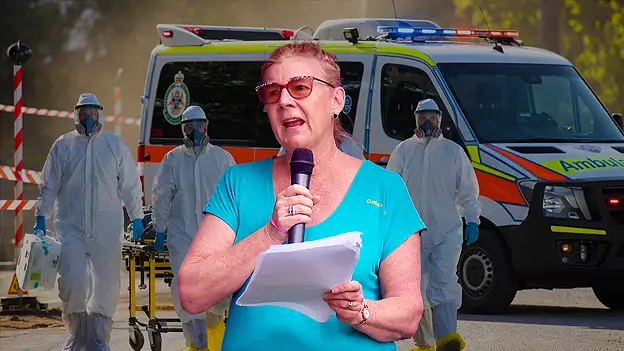

Debra Yuille:
So there's two agreements that we're talking about. One is the international health regulations and the other is the pandemic treaty. Now the international health regulations actually went through in May 20, or actually the 1st of June 2024. And we had until the 19th of July this year to reject them.
Australia did not reject those international health regulation amendments. And on Friday the 19th, that's this coming Friday of September, they do apply to Australia.
Now it's not all bad news. So I'm going to give you the bad news and then I'm going to give you a bit of information about some things we can still do to push back on that. The other treaty is the pandemic treaty as it's known. It has not yet been passed, right? It is still in play. Now there was a big show and tell, I'm going to call it theatre at the 2024 International Health Conference.
I can't remember the name of it right this second, but anyway, we'll get there. Where it appeared that Penny Wong was endorsing this on behalf of Australia. It appeared that they had a vote and it was agreed to except for the annex on the PBAS. The PBAS is the Pathogen Benefit Access Sharing. I'm going to come back to that in a minute as well.
Now even the mainstream medical press, if you like, are saying that they don't think they'll even be able to pass that in 2026, which is next May, which is good news. That doesn't mean we should ignore it, but it is not a blade out mezia. And the main reason for that is that they're still discussing how the financial part of that is going to work. So it's all about the money.
So essentially, as Tristan just said, we have the World Health Organisation who's an unelected international body and it now has the power to declare a public health emergency of international concern, a PHEIC.
Now it's the WHO that defines such emergencies including potential threats. So something could be, possibly, might be and they can declare an international health emergency of international concern. Now it's the World Health Organisation stakeholders who stand to benefit the most from these declarations. Now, those stakeholders are the pharmaceutical companies and others that make money or pharmaceutical type products.
Compounding the issue is the government's failure to reject the 2024 amendments as I just explained. Those amendments do dramatically expand the WHO's power over how countries, including Australia, manage public health. Now the Australian Medical Professional Society, AMPS, has put out a report called Follow the Money. If you want to see where the money's coming from, now when the money comes from outside contributions, each country that belongs to the World Health Organisation has contributions that it has to make.
Australia is making more contributions currently than we have to make, but over and above that, there are other organisations, private organisations of which we can confidently say 97% are connected in some way, shape, or form to the pharmaceutical companies and of the 3% that we can't say is just because we can't find the information in my opinion.
Now, those global corporate stakeholders include two that absolutely shocked me. One was ... I'm trying to find the right word with this. So there's organisations attached to legitimate companies and two of the ones that shocked me were Lego and Ikea. And it exposes how these entanglements may be influencing international health policy in ways that serve commercial rather than public interests.
Now, it might seem like this topic is not very flashy or entertaining, but it is critically important to us and we, the Australian public, deserve to understand the true implications of what's unfolding. So if you only take one message away today, please let it be this. Australians will not benefit from handing control of our health policy to an international bureaucracy beholden to global corporate interests, particularly not when the director general of that organisation is a gentleman by the name of Ted Ross who has allegedly got contacts to terrorist organisations and we have already seen with monkeypox where he can unilaterally make a decision and everybody follows suit, even those herds advisors are advising something else.
We risk the loss of civil liberties of medical freedom, including the right to bodily autonomy and of economic self-determination as taxpayer dollars are diverted into global profit streams. The World Health Organisation played a central role in the mismanagement of COVID-19 and to now expand their authority over future pandemic responses is at best irresponsible and at worst dangerous.
And the truth is that still now most Australians are unaware that these IHR amendments and the associated pandemic treatment, they don't even know that they exist. If they understood at stake, I believe the overwhelming majority would say, "We do not consent."
The IHR amendments are already being implemented into domestic law, like in WA where they now allow for forced medical treatment and these amendments are legally binding. The pandemic agreement on the other hand is a global proposal that's still being negotiated, but its direction is clear.
It's about centralising control, fast tracking medical products and sharing profits. Between these two documents, governments will be able to enforce the use of untested or likely tested medical treatments produced in as little as a hundred days without liability while also placing limits on your movement and maybe even requiring mandatory testing.
So this isn't just about the law, it's about your bodily autonomy, your rights, and who gets to decide what happens to you in the next emergency or potential emergency and this is truly terrifying.
So our health minister, Mr. Mark Butler, in June 2024, voiced his support to outsource Australia's health decisions to these unelected unaccountable bureaucrats and the World Health Organisation has a very questionable track record and severe conflicts of interest and that's one of the things that the Australian Medical Professionals Report really points out when you're looking to see if there's a conflict of interest when you're in auditing, you look to see where the money is coming from and going to.
That is a major tell, and these are simply not the people you want to be making health decisions for you and your family. Now, a lot of people may think that the World Health Organisation is a good organisation.
Well, if it ever was, it isn't anymore. It was established in 1946 with the greatest of intentions, but it's become severely compromised and is now heavily reliant on those donors who tell the World Health Organisation what to do. We've essentially employed the wolf to guard the henhouse.
Australia has already established an entity called the National IHR Authority and its role is to coordinate the implementation of the regulations, which we are meant to have it completed by the 19th of September (2025), i.e. next Friday. We've been told we have to adjust our domestic legislation and administrative arrangements to facilitate the National IHR Authority and provide unspecified potentially significant funding to the World Health Organisation via a coordinating financial mechanism.
Now I'm going to come back to that quote ordinating financial mechanism in a minute to promote the provision of timely, predictable and sustainable financing for the implementation of the regulations, i.e. Australia pays to enforce what the WHO says and also facilitates the distribution of pharmaceutical products with extraordinary enforcement powers and limited ability to object despite the fact that the risk of a naturally incurring pandemic is very, very low, right?
It might happen maybe once in a hundred years and I personally, my opinion is that the only reason something becomes a pandemic is because there's a media push to scare people and to put fear into people.
Now the World Health Organisation will be the arbitrators of truth. They will decide what is missing disinformation and they have the ability to censor Australia and Australians. They will have the authority to disclose Australia's personal information, so our personal health records. So if you're on any kind of health record, get yourself off there, please.
Don't give them any more ammunition to be able to force you into treatments.
Now they also have the power to tell transport or conveyancing operators what can happen to their passengers. This is specifically in relation to air and sea travel. So when we're here in Australia, we have our sovereignty, but as soon as we step on board a ship or a plane, then the captain of the ship can basically tell us what to do and the World Health Organisation can tell the captain of the ship what to do.
Did we all follow that? So they have the power to isolate or quarantine travellers, force vaccination or other prophylaxis, undergo the least invasive or intrusive medical examination that would achieve their public health objective or whatever else they deem necessary to prevent the control or spread of disease.
Now in the amended international health regulations, the word shall S-H-A-L-L appears 351 times.
Now you may remember that I was talking now some years ago about human rights and fundamental freedoms of persons. Well, they've left those words into the amended health regulations, but they're doing a damn good job saying we shall do a whole lot of other things through the document.
You do just have to say no, but we also need to educate other people about what's going on so that they know they can say no.
Now I mentioned that the funding mechanism and I would come back to it.
So there's an article being inserted into the international health regulations just before they were voted on in May 2024 called the 44 BIS. So amendments to the international health regulations were being debated for 18 months to two years prior to that, but this article 44 BIS only appeared at the last minute and it's the one about funding mechanism.
Now just before I get into that, let me tell you what the health assembly has authority to adopt. So the health assembly is the annual meeting of the World Health Organisation. So these are the things that they have the authority to adopt regulations about sanitary and quarantine requirements and other procedures designed to prevent the international spread of disease.
Non-commultures with respect to diseases, cause of death and public health practises, standards with respect to diagnostic procedures for international use, standards with respect to the safety, purity, and potency of biological pharmaceutical and similar products moving in international commerce and advertising and labelling of biological pharmaceutical and similar products moving in international commerce.
Now, did anyone hear anything in there about financial concerns? Was there anything in what I just read out that sounded anything like that? No, there was not. So in adopting this 44 BIS, they're actually going against their own constitution.
So our Australian government produced a thing called the National Interest Analysis about a category one treaty to decide whether they should push back on this or not. And this is what they had to say on the coordinating financial mechanism.
A new component of the amended IHR is the coordinating financial mechanism. This will function under the authority and guidance of the World Health Association and be accountable to states parties so they call country states. The coordinating financial mechanism seeks to increase the availability of funding for states parties to develop and maintain their core capacities, including by working to promote the provision of timely, predictable and sustainable financing to assist state parties to develop, strengthen and maintain the IHR core capacities.
This is completely outside their remit of what they are allowed to do under their own constitution. There's also maximising the availability of financing for this purpose in particular for developing countries and increasing the efficient utilisation of existing financial instruments.
Now, I can't see Australia being a beneficiary of any of this money. I can see us putting more, this is my opinion, I can see us paying more money off overseas to prop up this corrupt organisation.
Now according to the Australian government, the coordinating financial mechanisms will work towards these objectives by conducting needs and gap analysis, promoting coordination of existing financing instruments, identifying financing sources available for implementation support and supporting states parties in identifying and applying ... Where did I go? For organisations and other entities supporting state parties to develop, strengthen and maintain their core capacities. The coordinating financial mechanism does not create any new mandatory financial obligations on state parties.
Really do we truly think that Australia isn't going to be giving more money across for this? This approach, according to the government, is in Australia's national interest as it provides the prospect of better and more efficient financing support for countries needing assistance to develop and maintain the core capacities under the IHR.
Australia will benefit apparently when other countries have higher preparedness and response capacities, particularly in pandemic emergencies. Well, I think that's a load of rubbish and that's the message that we need to get out to the wider Australian community.
So in regard to the pandemic treaty, this has not yet been agreed to. There's a statement that says nothing is agreed till everything is agreed. So having said earlier that Penny Wong has done a big song and dance about this at the World Health Association's meeting in May of this year, that's wrong, right? They're making it seem like that's the case.
It's theatre because until the Pathogen Access Benefit Sharing and access agreed, there is no agreement. So what is this PABS? It's basically surveillance running around looking for organisms that have pandemic potential.
Now organisms and we've had been in this world a long time as people, right? We've roamed this place. Whatever they're going to find's already been in existence, but what they want to do is they want to take this. They want to tell us that if we find something that they think has, or we think has pandemic potential, we first of all have to tell them and then we have to share it with labs all over the world.
Why would we want to do that? What are they going to do in those labs? Does anyone think that maybe they might be starting to experiment on it and turn something that's got potential into something that could actually cause harm? Because that's what I think could happen.
And as I said before, the biggest sticking point is how much money gets paid to whom? So all is not lost. There's a lot we can push back on.
Now, many of you I hope have participated in campaigns, not just that Australia Exits The WHO has run, but also other organisations. And you'll notice that you get very similar responses back from whoever it is you're writing to. The reason for this is because there's a thing called the Parliamentary Library and because there's been a lot of pushback against the WHO intentions with the International Health Regulations Amendments and the Pandemic Treaty, they've actually put out what you call a press release to all of the politicians.
And the reason we're all getting the same stuff back is because they're all singing from the same hymn sheet.
So what can you do? You can keep talking and sharing because we need to get this information outside of the bubble that we're in. We need to get this out to middle mainstream Australia.
So back in 2023, when Australia Exits The Who started opposing the amendments, we discovered that there was incorrect information coming from the Parliamentary Library. And in my opinion, the Parliamentary Library is providing information that aligns with the view of the government of the day.
So we need to keep the politicians knowing that we are concerned. We need to let the parliamentary library know that maybe what they're putting out isn't quite true and we also need to support organisations like CitizenGo and Australia Exits The WHO among others. These changes along with the currently being drafted pandemic treaty are of grave concern and will obligate Australia to follow the directives of the World Health Organisation and its donors.
Australia must not agree to any further commitment with the World Health Organisation until it can be established that they're working for the betterment of Australians and not their corporate donors, which is an organisation responsible for advising on global health must be of the highest integrity with no conflicts of interest and the utmost accountability and review.
So therefore Australia needs to exit the World Health Organisation. We also need to exit the International Health Regulations and probably we're going to need to exit the pandemic treaty.
So that's what we need to keep pushing for. Thank you.